In hydraulic, pneumatic, and industrial piping systems, O-rings (sealing rings) play a critical role in preventing leakage of fluids and compressed air. However, selecting the wrong material or specification of O-ring can lead to hardening, permanent deformation, or melting, causing unscheduled equipment downtime.
This article will help you classify common O-ring types, master practical applications, and discover specialized O-ring lines dedicated to extreme operating environments.
1. Classification of Common O-ring Types by Material:
Each working environment (oil/grease, hot water, chemicals, or high temperatures) requires a specific rubber/polymer type. Below is a summary table of the core technical characteristics of the 5 most common O-ring types today:
|
O-RING TYPE (MATERIAL) |
OPERATING TEMPERATURE RANGE |
WORKING |
ENVIRONMENTS TO AVOID |
|
O-RING NBR (NITRILE) |
-30°C - 100°C |
Mineral oils, hydraulic greases, fuels, compressed air. |
Strong corrosive chemicals, outdoors (Ozone/UV rays). |
|
O-RING VITON (FKM) |
-20°C - 200°C |
Concentrated fuels/oils, chemicals, high-temperature environments. |
Strong organic acids, extreme cold/cryogenic environments. |
|
O-RING SILICONE (VMQ) |
-60°C - 200°C |
Food safety, medical applications, wide temperature range resistance. |
Dynamic friction (poor tear and wear resistance). |
|
O-RING EPDM |
-45°C - 150°C |
Hot water, steam, detergents, outdoor weather. |
Strictly avoid Mineral Oils & Greases. |
|
O-RING PTFE (TEFLON) |
-200°C - 250°C |
Most corrosive chemicals, ultra-low friction. |
Environments requiring high elasticity and stretchability. |
2. Practical Applications of O-rings in Industries:
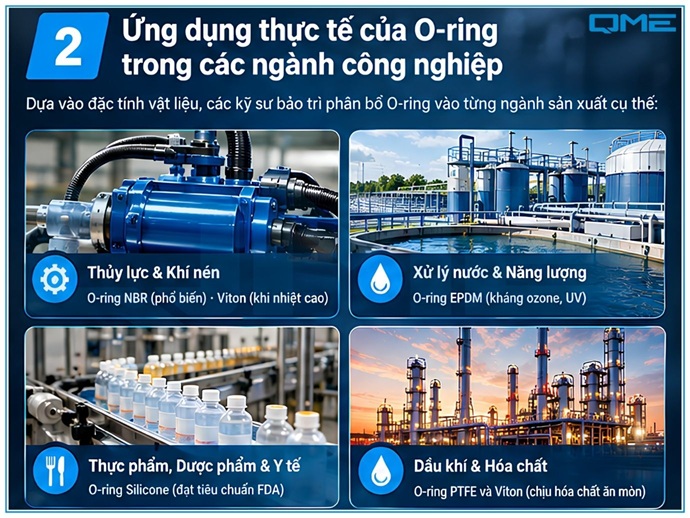
Based on the material properties above, maintenance engineers allocate O-rings to specific production sectors as follows:
- Hydraulics & Pneumatics Industry: NBR O-rings are widely used in hydraulic valves, cylinders, hydraulic pumps, and control valve assemblies. When the system operates continuously and generates high heat, Viton (FKM) O-rings serve as the perfect replacement.
- Water Treatment & Energy Industry: EPDM O-rings are extensively applied in water filtration systems, steam valves, and outdoor water supply/drainage pipelines due to their superior ozone and UV resistance.
- Food, Pharmaceutical & Medical Industry: Silicone O-rings meet safety and hygiene standards (FDA), being non-toxic and non-contaminating to the taste or odor of the passing media.
- Oil & Gas & Chemical Industry: PTFE and Viton O-rings are preferred at positions in direct contact with highly concentrated corrosive chemicals and solvents.
3. Important Technical Considerations When Choosing and Using O-rings:
To ensure the lifespan of seals and prevent the risk of sudden machine downtime, you should keep in mind the following 4 technical principles:
3.1. Extrusion prevention during high-pressure operation:
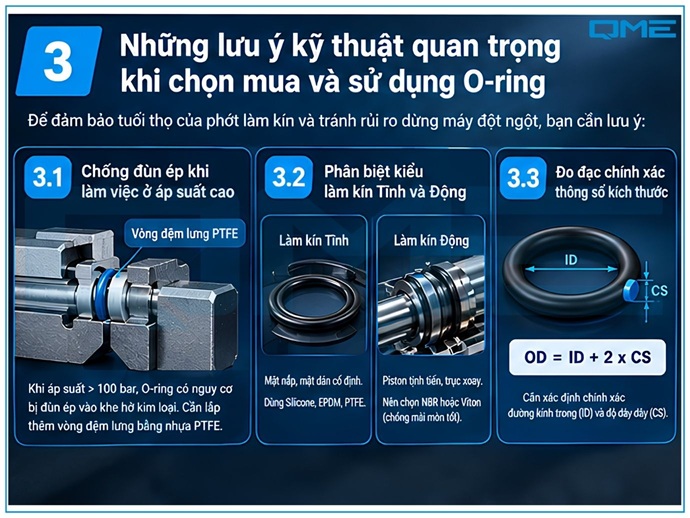
When system pressure exceeds 100 bar, rubber O-rings risk being extruded into metal clearance gaps, leading to seal tearing. In such cases, it is mandatory to install a PTFE Backup Ring to protect the O-ring.
3.2. Distinguish Static vs. Dynamic Sealing:
- Static sealing: Cover flanges, fixed joint surfaces. All material types such as Silicone, EPDM, and PTFE can be used.
- Dynamic sealing: Reciprocating pistons or rotating shafts. NBR or Viton should be selected for their excellent friction and wear resistance.
3.3. Accurately measure dimensional parameters:
When ordering replacement O-rings, accurately determine the 2 standard dimensions:
- Inner Diameter (ID).
- Cross Section (CS / cord thickness).
⇒ Quick calculation formula: Outer Diameter (OD) = Inner Diameter (ID) + 2x Cross Section (CS).
4. Special O-ring Types Few People Know About But Are Extremely Critical:
Besides general-purpose O-rings, modern production lines often demand specialized O-rings engineered with unique designs and features:
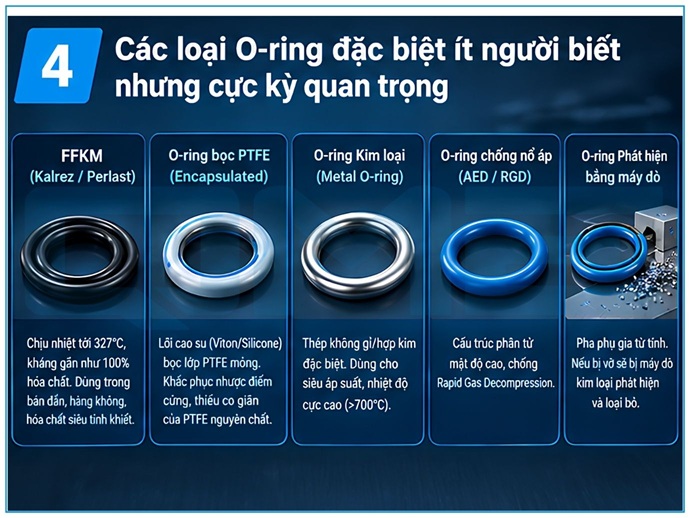
4.1. FFKM O-rings (Kalrez / Perlast):
Known as the ultimate premium O-ring class worldwide. FFKM withstands temperatures up to 327°C and resists nearly 100% of corrosive chemicals, commonly utilized in semiconductor manufacturing, aerospace, and ultra-pure chemical processes.
4.2. PTFE-Encapsulated O-rings:
This O-ring consists of an elastic rubber core (Viton or Silicone) enclosed by a thin outer jacket of PTFE (Teflon). This combination completely overcomes the stiffness and lack of elasticity of pure PTFE while preserving full chemical resistance.
4.3. Metal O-rings:
Manufactured from stainless steel or special alloys, used for ultra-high pressure and extreme temperature applications (exceeding 700°C) – where conventional rubber seals would burn or deform completely.
4.4. Anti-Explosive Decompression O-rings (AED / RGD):
High-pressure gas can permeate into the internal structure of rubber. Upon sudden depressurization, this trapped gas expands rapidly, causing internal rupture/tearing of the O-ring (Rapid Gas Decompression). Specialized AED O-rings are engineered with a high-density molecular structure to resist this phenomenon.
4.5. Metal Detectable O-rings:
In food and pharmaceutical production lines, these O-rings are blended with magnetic additives. If an O-ring breaks, fragments falling into products will be instantly detected and rejected by inline metal detectors on conveyor belts.
5. Purchase Genuine, Full-Range O-rings at QME:
Quang Minh Equipment Joint Stock Company (QME) is a leading reputable provider in Vietnam specializing in genuine sealing solutions, hydraulic equipment, and industrial seals.
- Rich Inventory: Readily stocks a comprehensive range of NBR, Viton, Silicone, EPDM, and PTFE O-rings, as well as versatile O-ring kits according to AS568, JIS B2401, and Metric standards.
- Direct distributor of major seal and oil seal brands such as Freudenberg - NOK.
- Quality Assurance: All products have clear origins and full CO/CQ certifications.
- In-Depth Technical Consultation: QME's team of experienced engineers is always ready to assist with calculations and material selection tailored to each plant's operating conditions.
Need help finding the right O-ring code or getting a bulk price quote for your factory?
👉 Contact QME's Engineering Team today for prompt assistance!